
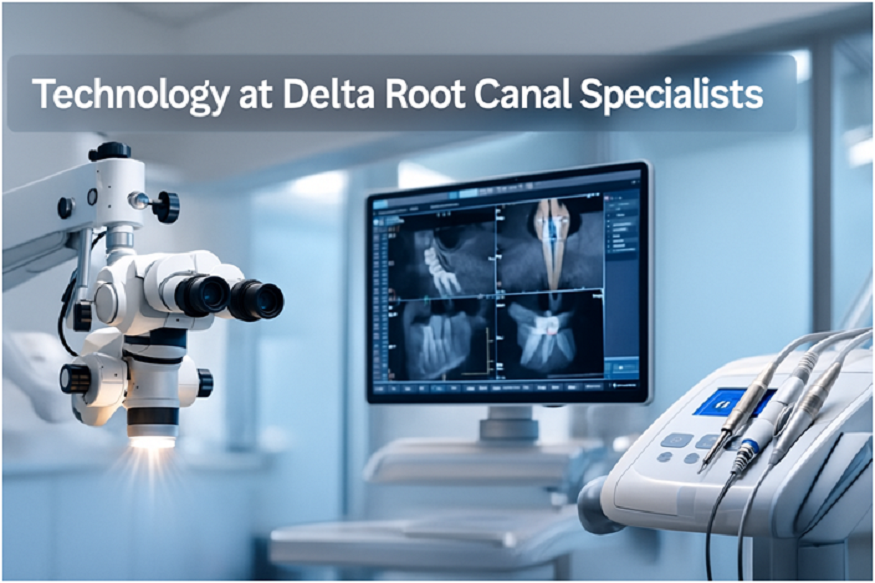

Modern dental care continues to evolve, and technology now plays a central role in delivering accurate, efficient, and comfortable treatment. Delta Root Canal Specialists integrate advanced tools into every stage of patient care to improve diagnosis and support successful outcomes. Endodontic treatment requires precision inside very small and complex spaces, and having the right technology allows the specialists to work with greater confidence and clarity. Patients benefit from shorter appointments, reduced discomfort, and treatment plans based on detailed, reliable information.
Digital Imaging for Clear and Accurate Diagnosis
Effective treatment begins with an accurate diagnosis, and digital imaging is one of the most important tools used at Delta Root Canal Specialists. High resolution images help the specialists see the internal structure of the tooth, including the canal shape, the presence of infection, and any cracks or fractures that may be hidden beneath the surface. Traditional X rays are helpful, but digital imaging provides much clearer detail and allows the specialists to analyze the tooth from multiple angles.
Better imaging also supports preventive decision making. Sometimes a tooth shows signs of early infection that may not be visible without advanced technology. Identifying these issues early allows the specialist to intervene before the condition becomes more severe. Patients benefit because they receive quicker diagnosis and timely treatment that helps protect their natural teeth for the long term.
Read More:The Role of Surgical Dentistry in Restoring Oral Health and Function
The operating microscope is another essential tool. Endodontic treatment requires work inside narrow, curved canals that cannot be seen with the naked eye. The microscope provides high magnification and bright illumination, making it possible to locate small canals, remove debris, and treat deep areas with accuracy. This reduces the chance of missed canals and improves the success rate of both root canal therapy and retreatment.
CBCT Scanning and Advanced Endodontic Instruments
Cone beam computed tomography, often called CBCT, offers a three dimensional view of the tooth and surrounding structures. This technology is extremely valuable when treating complex cases, retreatments, or teeth with unusual anatomy. A CBCT scan shows the exact shape of each canal, the depth of infection, and how close the roots are to other structures. With this information, the specialist can plan a more precise treatment and avoid complications.
Rotary instruments are also used during treatment to shape the canals smoothly and consistently. These tools operate at controlled speeds and help clean the canals with greater efficiency than traditional methods. Rotary instruments reduce procedure time and provide predictable results, which helps patients feel more comfortable during treatment.
Ultrasonic tools help clean areas that rotary instruments cannot reach. They vibrate at high frequency to remove debris, old fillings, and bacteria from inside the tooth. Using ultrasonic tools improves the quality of cleaning and supports long term healing because the canals are more thoroughly disinfected.
Technology That Enhances Comfort and Confidence for Patients
Technology is not only about improving clinical precision. It also helps create a more comfortable experience for patients. Shorter procedures, faster diagnosis, and more accurate treatment reduce anxiety and uncertainty. Patients appreciate knowing that the specialist has access to tools that reveal the full condition of the tooth and allow for targeted treatment.
Clear communication is part of this technology forward approach. High quality images help patients understand their condition and the recommended treatment plan. Seeing the problem visually makes it easier to trust the process and stay informed during each step of care.
Read More:How The Ritedose Corporation Delivers Excellence in Sterile Unit-Dose Manufacturing
Delta Root Canal Specialists combines advanced technology with extensive experience to deliver effective and predictable endodontic treatment. Each tool supports better diagnosis, efficient procedures, and stronger long term results. By focusing on accuracy, comfort, and patient education, the practice ensures that every individual receives care that protects their natural teeth and supports lasting oral health.